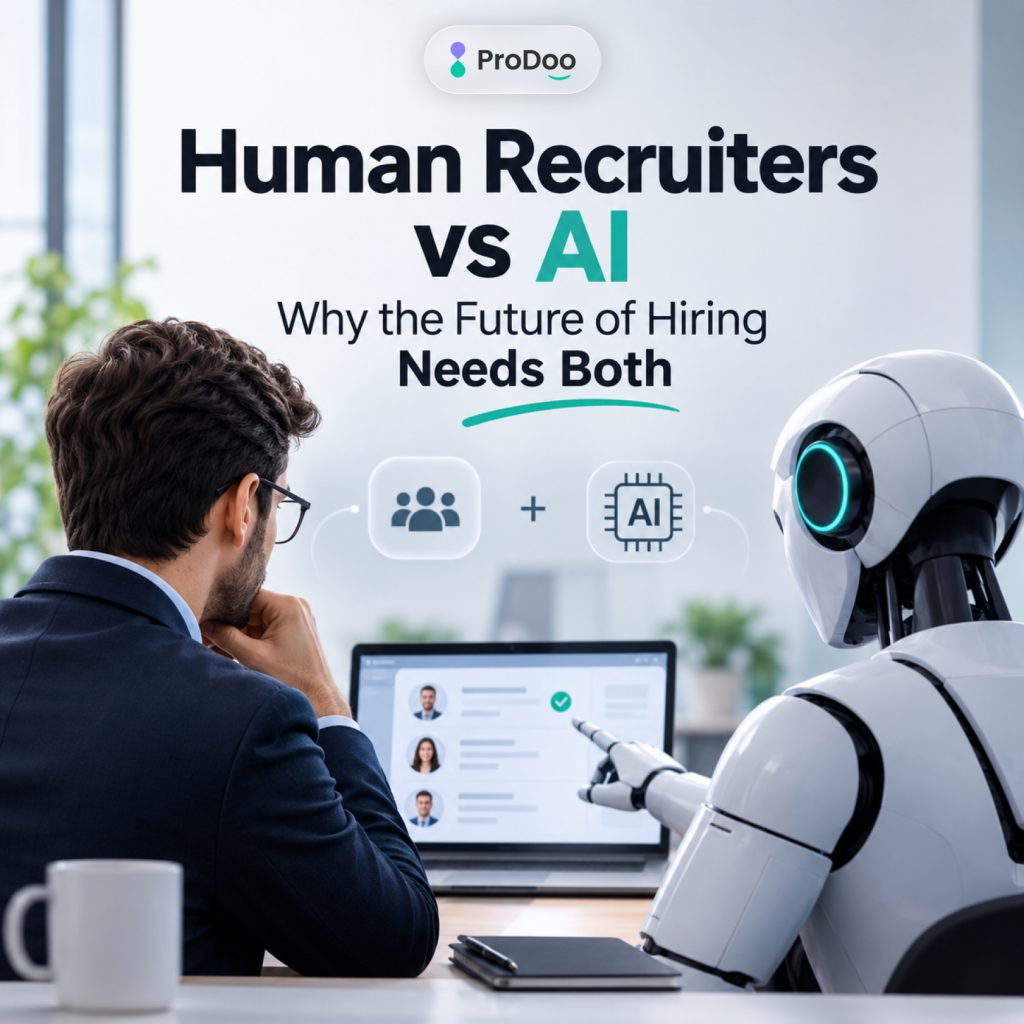
Human Recruiters vs AI: Why the Future of Hiring Needs Both
Artificial intelligence is changing recruitment quickly.
Tasks that once took recruiters hours, searching through profiles, screening applications, matching skills, drafting job descriptions, and organizing candidate information can now be supported by AI in seconds.
That naturally raises a question:
Will AI eventually replace recruiters?
Probably not.
The more realistic future is one where AI handles more of the repetitive work while recruiters focus on the decisions, relationships, and human understanding that technology cannot fully replace.
So the real conversation is no longer human recruiters versus AI. It is about how recruiters and AI can work together.
How AI Is Changing Recruitment
Recruitment has always involved a large amount of manual work.
A recruiter may need to:
- Review dozens or even hundreds of candidate profiles
- Search for professionals with specific skills
- Compare experience and qualifications
- Write job descriptions
- Send candidate messages
- Create shortlists
- Coordinate interviews
- Follow up with candidates and hiring managers
AI can make many of these processes faster.
Modern AI recruiting tools can help recruiters analyze large amounts of candidate information, identify relevant skills, recommend potential matches, automate routine communication, and organize hiring data.
This doesn’t mean that AI is making recruiters irrelevant. Instead, it changes where recruiters spend their time.
Rather than spending hours manually filtering profiles, a recruiter can spend more time understanding the role, evaluating the strongest candidates, speaking with professionals, and advising the hiring manager.
That is an important difference.
What AI Does Better Than Humans in Recruitment
There are areas where AI has a clear advantage.
1. Processing Large Amounts of Information
Recruiters have limited time. AI does not get tired after reviewing the fiftieth profile. It can process large amounts of structured information quickly and identify patterns that may take a person much longer to find.
For example, if a company needs a software developer with a particular combination of technical skills, industry experience, and availability, AI can help narrow a large talent pool into a more manageable group of relevant professionals. The recruiter can then focus attention where it matters most.
2. Candidate Matching
Traditional recruitment searches often depend heavily on keywords. But two candidates may describe exactly the same skill in different ways.
AI-powered candidate matching can go beyond simple keyword searches by considering related skills, experience, job requirements, and other available information. That can help recruiters discover professionals who might otherwise be missed.
3. Repetitive Recruitment Tasks
Recruiters perform many necessary but repetitive activities.
AI and recruitment automation can assist with tasks such as:
- Drafting job descriptions
- Organizing candidate information
- Creating initial candidate summaries
- Generating interview questions
- Scheduling
- Sending routine communications
- Identifying profiles that meet defined criteria
Automating parts of this work gives recruiters more time for higher-value activities.
4. Speed
Hiring delays can be expensive.
A strong candidate may also be speaking with several companies at the same time. Using AI to speed up sourcing, screening, and matching can help recruitment teams move from an open requirement to a shortlist more quickly.
But speed alone does not make a good hiring decision. That is where the recruiter becomes even more important.
What Human Recruiters Still Do Better
AI can analyze information. It cannot fully understand people. Recruitment involves far more than identifying whether someone has five required skills on a profile.
A candidate can look perfect on paper and still be wrong for the role. Another candidate may not match every keyword but could become the strongest person on the team. Good recruiters understand that difference.
1. Understanding the Real Hiring Need
A hiring manager might say:
“We need a senior developer with eight years of experience.”
A good recruiter asks more questions.
Does the person need eight years of experience, or does the company really need someone capable of independently leading a particular type of project?
What problem will this person solve?
Which skills are genuinely essential?
Could an experienced freelancer solve the requirement faster than hiring a permanent employee?
AI can help work with the information it receives. A recruiter helps determine whether the information itself is correct.
2. Reading Between the Lines
People are complicated.
Motivation, communication style, confidence, expectations, personality, career goals, and working preferences are difficult to reduce to a score.
A conversation may reveal that a candidate who appears ideal is not genuinely interested in the project.
It may also reveal that another candidate has exactly the kind of problem-solving ability the hiring manager needs.
Human conversations provide context that data alone may miss.
3. Building Relationships
Recruitment is built on trust.
Candidates want to know:
- What is the company really like?
- Is this opportunity worth pursuing?
- What does the hiring manager expect?
- Will the project help their career?
- Is the recruiter being transparent with them?
Hiring managers also rely on recruiters for advice.
They may need help understanding candidate availability, compensation expectations, market conditions, hiring difficulty, or whether their requirements are realistic.
These are conversations, not simply transactions.
4. Negotiation
- A candidate wants one rate.
- A company has another budget.
- The start date is difficult.
- The project scope changes.
A strong recruiter can understand what matters to both sides and help find a workable solution.
AI can provide information to support that conversation. But negotiation still requires judgment, timing, empathy, and trust.
5. Making Judgment Calls
Recruitment rarely gives you perfect information.
Sometimes two candidates are equally strong technically.
Sometimes a candidate has an unconventional background but excellent potential.
Sometimes the safest-looking candidate is not the best choice.
Hiring decisions require judgment.
AI can support that judgment.
It should not automatically replace it.
Human Recruiters vs AI: Who Is Better?
The answer depends on the task.
| Recruitment Task | AI | Human Recruiter |
|---|---|---|
| Processing large candidate pools | Strong | Limited by time |
| Searching and matching skills | Strong | Strong |
| Repetitive administrative work | Strong | Inefficient |
| Candidate relationship building | Limited | Strong |
| Understanding hiring-manager context | Supportive | Strong |
| Negotiation | Limited | Strong |
| Assessing motivation | Supportive | Strong |
| Handling unusual situations | Limited | Strong |
| Making final hiring judgments | Supportive | Essential |
| Providing strategic hiring advice | Supportive | Strong |
The strongest hiring process does not choose one side.
It combines them.
The Best Recruitment Model: AI + Human Judgment
Imagine a recruiter needs to find a specialist for an urgent project.
Without AI, the recruiter may spend hours searching profiles, adjusting filters, comparing experience, and creating a shortlist.
With AI, the system can help identify relevant professionals earlier.
But the recruiter still needs to determine:
- Is this person genuinely suitable?
- Does their experience match the actual project?
- Are they available when the company needs them?
- Does the opportunity make sense for the candidate?
- Can both sides agree on expectations?
This creates a much stronger division of work.
- AI finds signals.
- Recruiters interpret them.
- AI accelerates the process.
- Recruiters guide the decision.
That is where AI in recruitment becomes genuinely useful.
Will AI Replace Recruiters?
Some recruitment tasks will almost certainly become more automated.
Recruiters who spend most of their time performing repetitive administrative activities may see those responsibilities reduced significantly.
But that does not mean recruitment disappears. The recruiter role is more likely to evolve.
Future recruiters may spend less time manually searching databases and more time acting as:
- Talent advisors
- Candidate relationship managers
- Hiring strategists
- Skills specialists
- Market advisors
- AI-assisted sourcing experts
- Partners to hiring managers
In other words, AI may reduce the value of repetitive recruiting work while increasing the importance of human judgment and strategic recruitment skills.
Recruiters who learn to use AI effectively may therefore have an advantage over recruiters who ignore it.
The Risks of Relying Too Much on AI
AI is powerful, but recruiters should not treat every AI recommendation as fact.
There are several reasons.
AI Only Knows the Information Available to It
A candidate profile may be incomplete. A professional may have transferable experience that isn’t immediately obvious.
Someone may have developed important skills that are described differently from the wording used in a job requirement. AI recommendations should therefore be treated as useful signals, not unquestionable decisions.
Good Candidates Can Be Unusual Candidates
Great professionals do not always follow predictable career paths.
Someone who changed industries, worked independently, took a career break, or developed skills through unconventional routes may still be an excellent candidate.
Overly rigid automation risks filtering out exactly the kind of person a recruiter should investigate further.
Candidates Want Human Interaction
A hiring process can be efficient without becoming impersonal. Receiving automated updates is helpful. Feeling as if every interaction is with a machine is different.
For important roles and projects, candidates often want the opportunity to ask questions and understand the people behind the opportunity. Recruitment technology should reduce unnecessary friction, not remove human interaction entirely.
How Recruiters Should Use AI
The goal should not be to automate every possible step.
A better question is:
Which tasks can AI handle so that recruiters can spend more time on the work where human involvement creates value?
A practical AI-assisted recruitment process might look like this:
Step 1: Recruiter defines the hiring requirement
Understand the project, required skills, experience level, availability, budget, and priorities.
Step 2: AI supports talent discovery
Use intelligent search and matching to identify potentially relevant professionals.
Step 3: Recruiter reviews the shortlist
Look beyond match scores and evaluate the candidate’s actual experience and suitability.
Step 4: AI helps organize information
Summarize candidate information, prepare comparison points, or assist with interview preparation.
Step 5: Recruiter speaks with the candidate
Understand motivation, communication, expectations, availability, and genuine suitability.
Step 6: Recruiter advises the hiring manager
Provide context rather than simply forwarding profiles.
Step 7: Humans make the final decision
Use AI-generated insights as support, not as a replacement for accountability.
This approach provides the efficiency of technology without losing the human side of hiring.
Where Platforms Like ProDoo Fit In
For recruiters hiring independent professionals, the challenge is often not simply accessing more profiles.
The real challenge is finding relevant professionals faster.
Recruitment platforms can increasingly use AI to make talent discovery, matching, and hiring workflows more efficient.
At ProDoo, the opportunity is to bring intelligent technology into the recruitment process while keeping recruiters in control of the final decision. AI can help recruiters discover and evaluate relevant talent.
Recruiters still bring the context, conversations, relationships, and judgment required to turn a potential match into the right hire.
That balance matters. Because successful recruitment is not about finding the largest number of candidates. It is about finding the right person for the work.
The Future of Hiring Is Human + AI
The debate around human recruiters vs AI makes the future of recruitment sound like a competition.
It does not need to be.
AI is extremely good at processing information, recognizing patterns, automating repetitive work, and helping recruiters move faster. Humans are better at understanding context, building relationships, interpreting behaviour, negotiating, and making nuanced decisions.
The future belongs to recruitment teams that understand how to use both. The most successful recruiters will not compete with AI. They will know when to use it, and when human judgment matters more. And ultimately, that may be the biggest change AI brings to recruitment:
Less time spent processing candidates. More time spent understanding them.
Frequently Asked Questions
Can AI replace human recruiters?
AI can automate or support many recruitment tasks, including candidate sourcing, screening, matching, scheduling, and content creation. However, relationship building, negotiation, contextual understanding, strategic advice, and final hiring decisions still benefit significantly from human involvement.
How is AI used in recruitment?
AI in recruitment can be used for talent sourcing, candidate matching, resume screening, job description creation, candidate communication, interview preparation, recruitment analytics, and workflow automation.
Is AI better than recruiters at hiring?
AI is better at processing large amounts of information quickly, while recruiters are stronger at understanding people, context, motivation, and complex hiring situations. The strongest hiring approach combines AI capabilities with human judgment.
Will recruiters still be needed in the future?
Yes, although the recruiter’s role is likely to change. As more administrative recruitment tasks become automated, recruiters can focus increasingly on talent strategy, candidate relationships, hiring-manager advisory work, negotiation, and decision-making.
What are the benefits of AI for recruiters?
AI can help recruiters save time, manage larger candidate pools, identify relevant skills, improve talent discovery, reduce repetitive work, and potentially shorten parts of the hiring process.
What are the risks of AI in recruitment?
Potential risks include relying too heavily on automated recommendations, overlooking unconventional candidates, working with incomplete candidate information, reducing human interaction, and treating algorithmic scores as final hiring decisions.
Looking for a smarter way to find professional talent?
ProDoo helps recruiters connect with skilled professionals and manage the hiring journey more efficiently. Explore how technology can simplify talent discovery while keeping you in control of the people and decisions that matter.
Find the right professional. Hire with confidence.