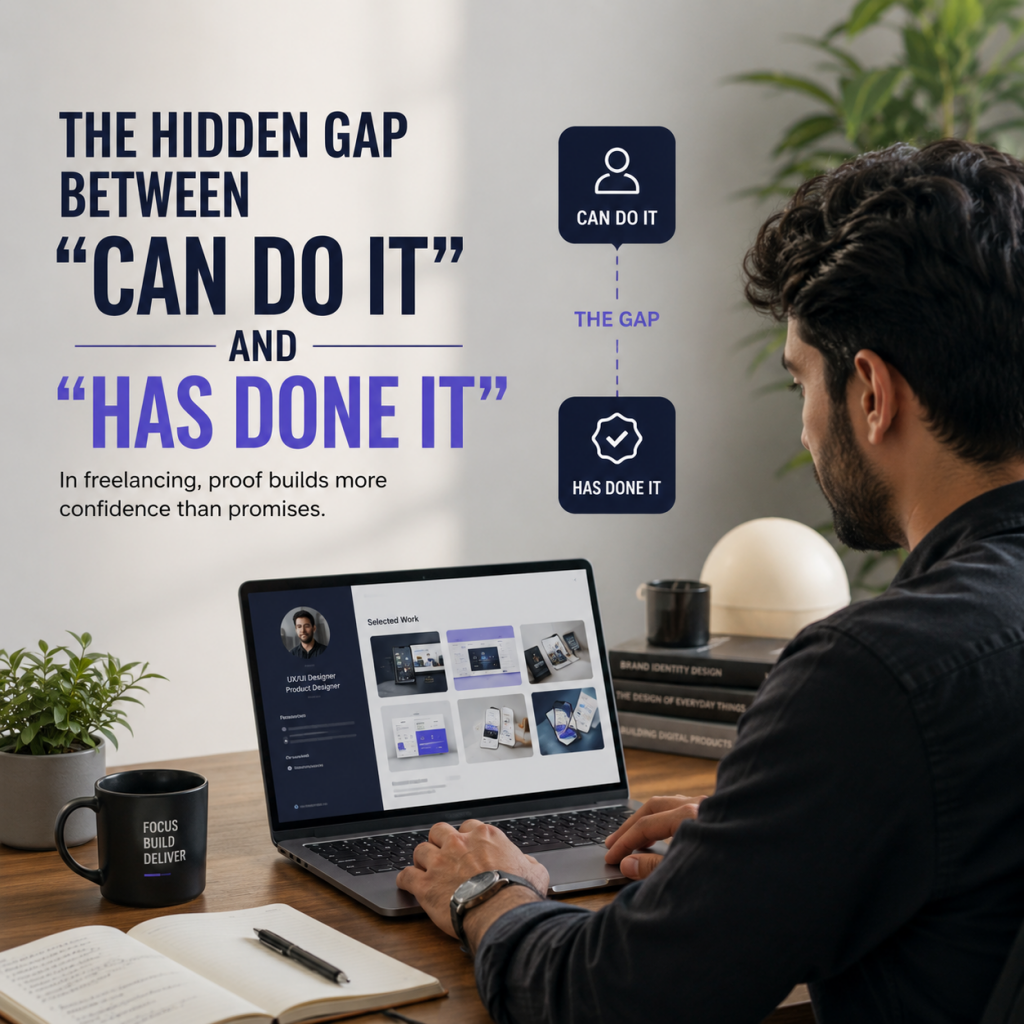
The Hidden Gap Between “Can Do It” and “Has Done It”
The Hidden Gap Between “Can Do It” and “Has Done It”
In freelancing, saying you can solve a problem is easy. Showing that you already have is what builds confidence.
A client posts a project.
They need a designer who understands SaaS products.
A developer who has worked with a particular tech stack.
A copywriter who understands B2B audiences.
Dozens of freelancers respond.
And many of them say the same thing:
“I can do this.”
But from a client’s perspective, there’s a much more important question:
“Have you actually done this before?”
That small difference can completely change a hiring decision.
“Can Do It” Is a Promise
When a freelancer says:
“I can design your website.”
They’re making a claim about their ability.
There may be truth behind it. They might genuinely have the required skills.
But the client still has to take a chance.
They don’t know how the freelancer handles real projects.
They don’t know how they deal with feedback.
They don’t know whether they understand the client’s industry.
And they don’t know whether the freelancer can deliver the quality they’re expecting.
Capability is potential.
But potential is difficult to evaluate from a few sentences.
“Has Done It” Is Evidence
Now imagine another freelancer responds:
“I’ve designed similar SaaS websites before.”
And instead of simply saying it, they can show relevant work.
Suddenly, the conversation changes.
The client can see the freelancer’s approach.
They can evaluate the quality.
They can understand the freelancer’s experience.
Most importantly, uncertainty decreases.
That’s the real power of demonstrated experience.
You aren’t asking someone to believe you.
You’re giving them something they can evaluate.
Clients Don’t Just Hire Skills. They Hire Confidence.
A hiring decision isn’t purely about technical ability.
Two freelancers can have almost identical skills, yet one can be significantly easier to hire.
Why?
Because the client feels more confident about the outcome.
Think about it.
If you need a freelancer to solve a specific problem, would you rather hire someone who says:
“I can probably handle this.”
Or someone who can show:
“I’ve solved something like this before.”
The second option reduces the perceived risk.
And in hiring, reducing uncertainty matters.
Your Portfolio Should Answer More Than “What Can You Make?”
A strong portfolio shouldn’t simply display your best-looking work.
It should help answer:
What problems have you solved?
For whom?
How did you solve them?
What kind of work do you consistently deliver?
That’s especially important for experienced freelancers.
Your previous work isn’t just something to show off.
It’s evidence of what you can actually do.
Relevant Experience Beats Random Experience
Having 50 projects doesn’t necessarily make you more convincing than someone with 10.
What matters is relevance.
Imagine you’re hiring a freelancer to create a financial dashboard.
A freelancer with 100 social media designs may be talented.
But another freelancer with 8 well-executed dashboard projects may give you more confidence.
Why?
Because their previous work is closer to the problem you’re trying to solve.
This is why iPros should think beyond:
“How much experience do I have?”
and start thinking:
“How relevant is my experience to the opportunity?”
There’s Another Side to This
This isn’t only a freelancer problem.
It’s also a hiring problem.
Employers often have to evaluate freelancers using limited information:
A profile.
A proposal.
A portfolio.
A few messages.
Maybe a call.
That’s not much information when you’re trying to decide who should be trusted with an important project.
And when every profile makes similar claims, finding meaningful differences becomes difficult.
This Is Where Proof Becomes More Valuable Than Promises
The more competitive the freelance market becomes, the less powerful generic claims become.
“I’m highly skilled.”
“I always deliver quality.”
“I’m an expert.”
“I’m passionate about my work.”
Almost anyone can say these things.
But evidence is harder to copy.
Relevant projects.
Real experience.
Consistent work.
Professional reputation.
Specific expertise.
These signals give clients something much more valuable than a promise:
a reason to believe.
iPros: Don’t Just List Your Skills
If you’re a freelancer, look at your profile today.
Don’t only ask:
“Have I listed everything I can do?”
Ask:
“Can someone looking at my profile see what I’ve already done?”
If you’re a video editor, show the type of videos you actually produce.
If you’re a developer, show the kind of problems you’ve solved.
If you’re a designer, show relevant projects rather than only visually impressive ones.
If you’re a copywriter, show the industries and formats you understand.
Your goal isn’t to convince everyone that you can do everything.
It’s to make the right client recognize your experience.
Employers: Look for Evidence, Not Just Confidence
For employers, the lesson is equally important.
A confident proposal doesn’t automatically mean a capable freelancer.
Look beyond the pitch.
Ask:
- Is their previous work relevant?
- Does their experience match the project?
- Can they demonstrate similar results?
- Does their professional history support their claims?
- Do they understand the actual problem?
The best hiring decision isn’t always about finding the person who sounds most confident.
It’s about finding the person whose experience gives you the most confidence in the outcome.
The Future of Freelance Hiring Is Becoming More Evidence-Driven
As more people enter the freelance economy, simply having a profile isn’t enough.
There are more choices.
More competition.
More claims.
More noise.
That makes credible professional information increasingly valuable.
Platforms that help employers discover what an iPro actually knows, what they’ve worked on and where their experience fits can make the hiring process much more meaningful.
That’s one of the ideas behind ProDoo.
The goal isn’t just to connect companies with freelancers.
It’s to make it easier for the right companies to recognize the right expertise.
From “I Can” to “I’ve Done It”
The strongest freelancers don’t have to convince clients that they’re capable of everything.
They can point to their work and let the evidence speak.
Because there’s a significant difference between:
“Trust me, I can do it.”
and
“Here’s what I’ve already done.”
The first creates a promise.
The second creates confidence.
And when the right opportunity comes along, confidence can be the difference between being considered and being chosen.