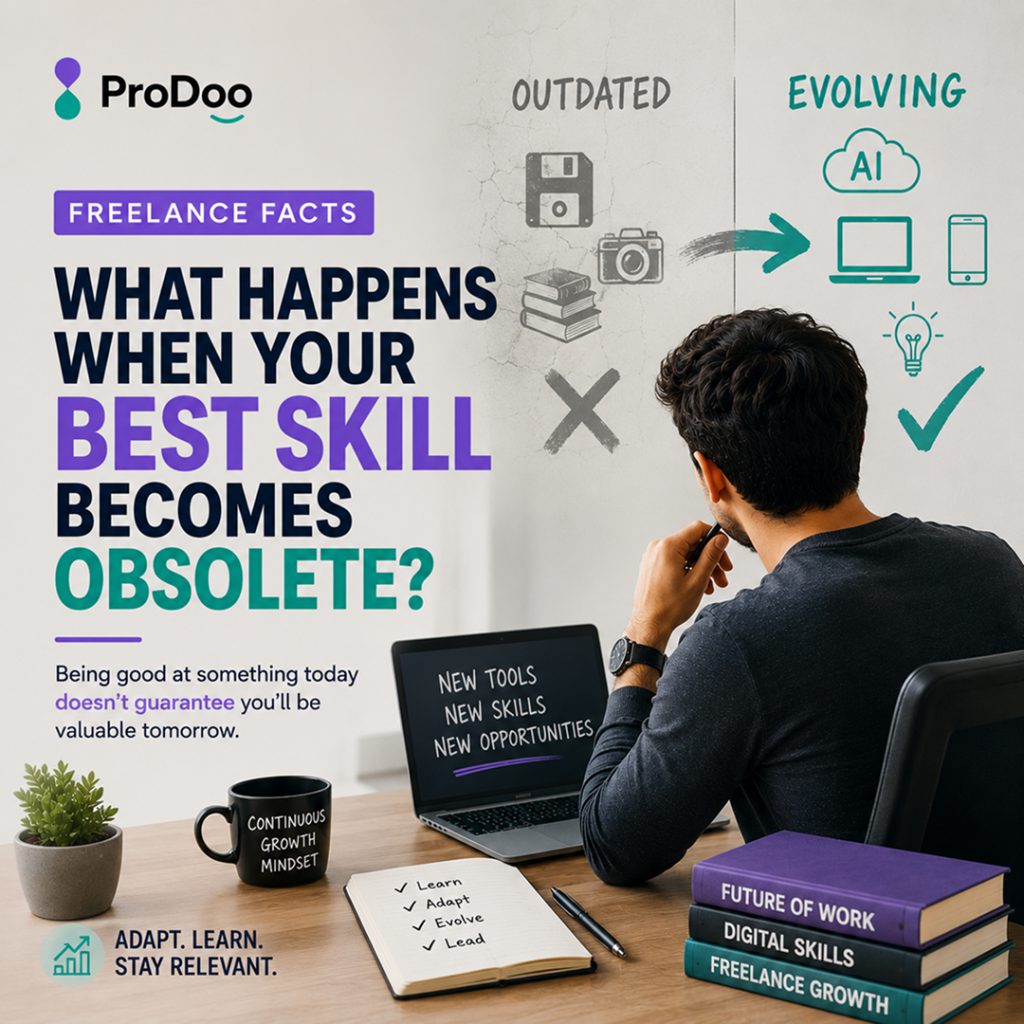
What Happens When Your Best Skill Becomes Obsolete?
Being good at something today doesn’t guarantee you’ll be valuable tomorrow.
Imagine you’ve spent five years becoming exceptionally good at one skill.
- You’ve built a strong portfolio.
- You have returning clients.
- You know your workflow inside out.
- You can finish projects faster than most people in your field.
Then the market changes.
A new tool appears.
A new technology changes how the work is done.
Clients start expecting something different.
Suddenly, the skill that made you competitive isn’t as valuable as it used to be.
What do you do?
This isn’t a hypothetical problem anymore. For freelancers, the ability to adapt is becoming just as important as the ability to specialize.
The Most Dangerous Skill Is the One You Stop Updating
Becoming highly skilled is important.
But there’s a difference between mastering a skill and stopping at mastery.
A freelancer who learned a particular tool five years ago may still be excellent at using it. But if clients have moved to newer tools, workflows, or technologies, being excellent at the old method doesn’t necessarily create the same value.
The market doesn’t reward experience simply because it’s experience.
It rewards relevant expertise.
That’s an uncomfortable reality.
Your Experience Still Matters, But It Needs to Evolve
When a skill becomes less valuable, your previous experience doesn’t suddenly become useless.
In fact, your experience can become your biggest advantage.
Consider a designer who has spent years understanding:
- User behavior
- Visual hierarchy
- Branding
- Conversion principles
- Client communication
New AI design tools may change how they create.
But those tools don’t automatically replace the judgment they’ve developed through years of working with real clients.
The freelancer who combines that experience with new technology can become more valuable than someone who only knows the new tool.
The goal isn’t to throw away your expertise. It’s to upgrade it.
Don’t Compete With Technology. Learn to Use It.
One of the biggest mistakes freelancers can make is treating new technology as an enemy.
When a new tool can perform part of your job faster, you have two choices:
Ignore it and continue working the old way.
Or:
Understand it and figure out where your expertise fits into the new workflow.
The second option is usually more sustainable.
A copywriter who learns AI-assisted research can potentially produce better work faster.
A developer who understands AI coding tools can spend more time on architecture and problem-solving.
A designer who uses generative tools intelligently can explore more concepts while focusing their expertise on design decisions.
Technology can change the process without eliminating the value of human judgment.
The Market Gives You Warning Signs
Skills rarely become obsolete overnight.
There are usually signals.
Pay attention when:
- Clients start asking for different tools.
- Job descriptions begin mentioning new technologies.
- Competitors start offering new services.
- Tasks that once took hours become automated.
- Your usual service becomes increasingly price-sensitive.
- You’re getting fewer opportunities despite maintaining the same quality.
These aren’t necessarily reasons to panic.
They’re reasons to pay attention.
The 70/30 Approach
You don’t necessarily need to abandon your current specialization and start from zero.
A smarter approach can be:
70% — Strengthen what you’re already good at.
30% — Explore what’s changing around it.
This allows you to stay productive while continuously preparing for what’s next.
For example, instead of completely changing your career from graphic design to AI, you might learn how AI can improve your existing design workflow.
Over time, that 30% can become a larger part of your expertise.
Ask Yourself These 5 Questions
Every freelancer should periodically ask:
1. Is my skill still in demand?
Don’t rely only on what clients used to ask for.
Look at what they’re asking for now.
2. What part of my work can technology automate?
Don’t be afraid of the answer.
Understanding automation gives you time to focus on higher-value work.
3. What can I do that a tool can’t easily replace?
This could be strategy, creativity, communication, problem-solving, industry knowledge, or decision-making.
4. What skill should I start learning before I need it?
Learning when demand is already high means you’re always catching up.
5. If I started freelancing today, would I learn the same skill?
This might be the hardest question.
And possibly the most useful one.
Don’t Wait Until Your Income Drops
One of the biggest mistakes freelancers make is learning only when they are forced to.
They wait until:
“Clients aren’t hiring me anymore.”
Then they start looking for something new.
By that point, they’re already behind.
A better strategy is to keep learning while your existing skill is still paying the bills.
Your current income can fund your future expertise.
The Freelancers Who Adapt Will Have an Advantage
The future doesn’t necessarily belong to freelancers who know the most tools.
It belongs to freelancers who know when to learn a new tool, why to use it, and how to combine it with real expertise.
Technology will continue to change.
Client expectations will change.
Entire workflows will change.
But the ability to learn, adapt, and solve meaningful problems will remain valuable.
Final Thoughts
Your best skill got you here. But it may not be the skill that takes you where you want to go next. That’s not a reason to abandon everything you’ve built. It’s a reminder to keep building on it.
Don’t protect your skill from change. Prepare your skill for change. Because in freelancing, staying relevant isn’t about knowing everything. It’s about making sure you’re still valuable when the market moves.
Freelance Fact
Your experience gives you a head start. Your willingness to adapt determines how far you go.